
Online political advertising didn’t decide the Saxony-Anhalt election. But its disappearance probably helped shape the result.
In October 2025, the European Union’s “Transparency and Targeting of Political Advertising” regulation (TTPA) came into force. At the same time, Meta and Google left the EU political advertising market, arguing the new law made things too operationally complex.
We’ve argued before that the regulation over-stretched, adding “targeting” to what should have been a primarily transparency and advertiser verification-based remit. A more limited scope would likely have seen the platforms continue to offer political advertising services to all-comers in Europe.
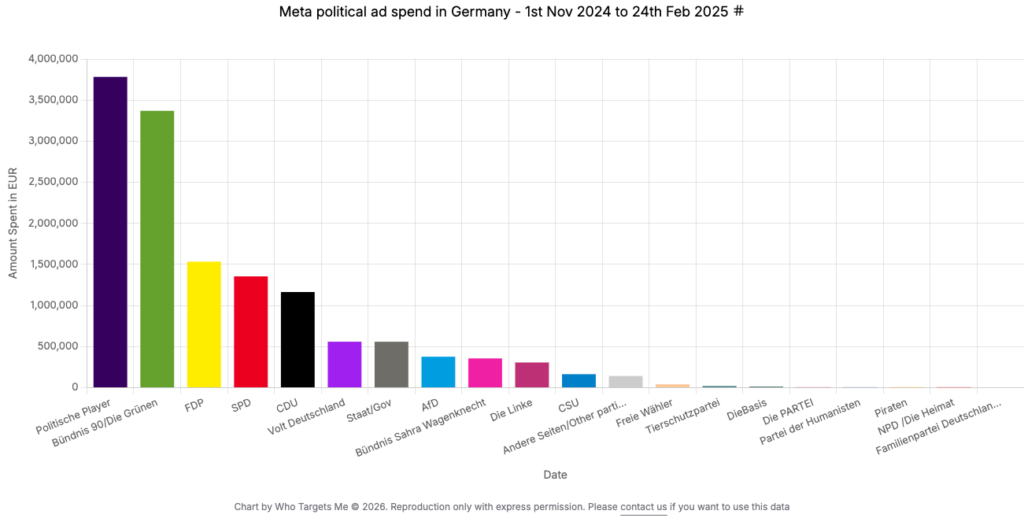
This matters because mainstream political parties used these platforms much more than the far right did. Although German parties were never among Europe’s biggest buyers of digital political advertising, parties and other political actors still spent around €14 million on ads in the three months before the 2025 federal election. The AfD accounted for just 2.75% of political ad spending on the major platforms. The Greens spent around ten times as much, while the CDU and SPD each spent roughly five times more. When online political advertising effectively stopped, the biggest losers weren’t the extreme right, but parties in the political centre.
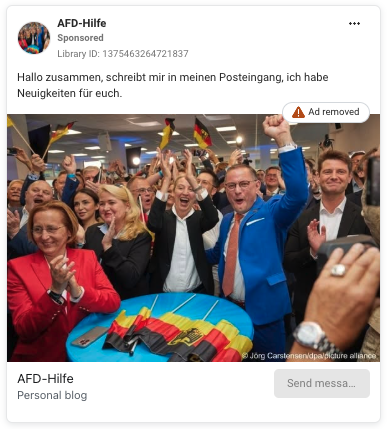
In Sachsen-Anhalt all parties had an effective digital ad spend and reach of zero. (Meta’s imperfect implementation of its own ban meant a few hundred ads mentioning the AfD, CDU and SPD still slipped through over the past months, but they generated little reach and very few originated from official campaigns.)
But what’s left when millions of paid political ads, one of the few transparent, attributable and verified campaigning tools, disappear?
Everything else.
Algorithmic feeds still reward emotionally charged content. Political influencers continue to reach millions. Highly engaged networks, domestic and foreign, remain able to reach voters without buying a single advertisement.
These are also the parts of the online ecosystem in which parties willing to push emotionally charged messages, particularly around immigration, crime and national decline, have proved most effective. The immediate mutual gratitude between Ulrich Siegmund, the AfD’s main man in Saxony, and Elon Musk speaks to how highly these supportive channels are valued by the party (and its European counterparts).
The TTPA clearly wasn’t designed to help the far right, but it should be judged by its effects. By removing a campaigning tool that mainstream parties relied on disproportionately, while leaving alone the mechanisms that reward polarising content, the regulation shifted the balance of online campaigning in favour of the AfD and other European far-right parties.
There still seems to be little appetite in the EU to revisit the regulation to make it fairer. Even if that happened, it’s not obvious that Meta and Google (let alone others) would re-enter the political advertising market.
Our argument isn’t that unrestricted political advertising should return. Setting a baseline for political advertising transparency is an extremely valuable thing to do. But in trying to solve one problem too many (the way ads were targeted, over and above what is allowed by the GDPR), the overall situation has been made worse.
The ironic result is that Europe now has less transparency in digital campaigning than much of the rest of the world, while making life easier for the parties that depend least on paid political advertising.