
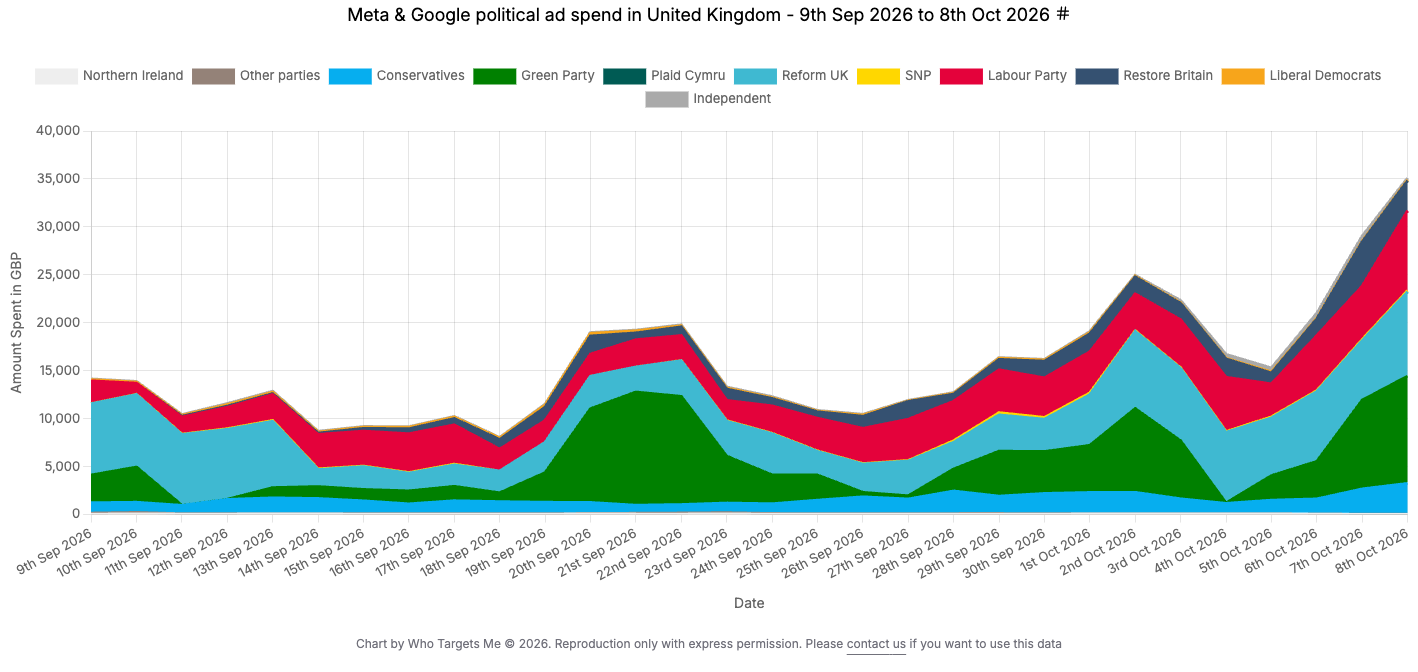
Aka: Honey, we should shrink the spending limits
This post isn’t about the content of the advertising or the outcome of the Holborn and St Pancras by-election, but rather the sheer volume of digital material campaigns paid to put in front of voters during the campaign. The by-election wasn’t especially unusual (though Reform and Restore spent much more than parties with no chance of winning normally would), but instead it’s a good example of the growing gap between how we regulate elections and how campaigns actually operate.
As best we can (the data we can glean from the platform ad libraries is blurry), we think around £215,000 of digital advertising was bought by the various campaigns across a range of different advertising accounts (Meta, YouTube, candidate, party, local party and party leader pages).
If you take a fairly standard cost of £8 per 1,000 ad impressions for social media ads, that means 27M ad impressions were bought during the campaign.
That’s the equivalent of 382 ad impressions for each of the 70,302 eligible voters in Holborn and St Pancras, or 10-15 per voter per day of the campaign.
Of course, not all these impressions will have reached registered voters. Some will have gone to commuters, visitors and people living outside the constituency. And some people will have seen far more advertising than others. But the scale is really extraordinary.
The cost of reaching voters
Let’s try to compare that to direct mail and leafleting.
A British parliamentary candidate is entitled to one piece of direct mail delivered, for free, by the Royal Mail, to either a household, or a named individual voter. They still have to cover the printing costs, but the delivery is free. If you’ve got everything perfectly lined up with the Royal Mail, your message could hit the doormats in about a week.
If you want to send a second piece of direct mail, you’ll have the same production cost, plus the cost of postage to get it to the letterbox. That’s potentially tens of thousands of pounds to reach all the households a second time. With a campaign expenditure limit of £180,050 for your entire by-election campaign (much less for a normal parliamentary election), you’re going to need to really, really believe in the power of direct mail to send that second piece.
Which brings us to the next option – leaflets.
Leaflets and door knocking are the lifeblood of British political campaigns. They give your members something to do, while helping you gather data about how voters feel “on the doorstep”. Most importantly, canvassing conversations tell you who to “knock up” (unfortunate phrase) on polling day, in order to make sure they’ve voted.
Leaflets turn volunteers into an informal postal service. Give each of them a few streets to aim at and a couple of bundles of leaflets and you’re “getting the message out”, every evening and weekend for the duration of the campaign. Leaflets are pretty cheap to produce (often just a few pence each in large print runs, though can be more for more sophisticated designs and layouts) and can be “targeted”, in that you can focus your efforts on areas or even houses, where you know your voters, or those most likely to be persuaded, live. They’re also persistent, in that they still arrive whether or not someone is paying attention and can be delivered when no one is home.
That said, they do take a long time to distribute, and they’re less likely to reach people with loud, barking dogs, letterboxes they never check or who are quick to recycle.
Despite the limitations, the economics of traditional constituency campaigning are built around the physical work of reaching households. The typical way a general election candidate’s spending limit is set is by multiplying the number of voters by a figure (which varies depending on whether it’s an urban or rural constituency) and adding a chunk for fixed costs.
Volunteers vs Platforms
Delivering 10 leaflets to 10 households using volunteers takes around 10 minutes and costs perhaps 20–50p in printing, depending on the specification and print run.
Therefore, for a typical urban constituency like Holborn and St Pancras, of roughly 50,000 households, delivering 500,000 leaflets (10 per household) might cost £10,000–£25,000 to print, and 8-10,000 hours of volunteer time, assuming an average one leaflet delivery per minute. If we were to pay our volunteers a London Living Wage (we won’t and don’t), we’d have added up to £150,000 of implied labour cost to the campaign.
So even a modest programme of ten leaflet deliveries per household represents a significant logistical undertaking. It requires printing, sorting, organising volunteers and thousands of hours of walking around streets.
Now compare that with digital advertising. At £8 CPM, £200,000 buys 25 million impressions. That’s 50 times as many ad impressions as our 500,000 leaflet deliveries, without needing an army of volunteers to distribute them or a week to get the Royal Mail moving.
These aren’t equivalent contacts. A leaflet on a doormat isn’t the same as an ad appearing in someone’s feed. Neither guarantees a voter will read the message. But the difference in the scale and speed of distribution is enormous.
And yet our approach to election spending limits still behaves as if reaching voters means physically delivering things to them.
Inflation: The wrong measure
Before the last election, the Conservative government increased national party spending limits by 80% (to £34.1m for a party running in all seats across England, Wales and Scotland). By-election candidate limits also rose by 80%, while ordinary general election candidate limits increased by around 32%.
They were able to do this, without any broad public consultation, because the limits hadn’t been increased with inflation for many years. If there had been a debate, we’d have argued that inflation was the wrong measure to base it on.
When you look at the cost of campaigning over time, the core inputs either have not risen at all (volunteers are still free, as is Royal Mail delivery for the first item) while others have risen much more slowly than inflation. The ONS says the cost of printing services has gone up by around 37% since 2006, compared with overall inflation of around 73%.
Added to this, digital advertising (let alone organic social media campaigning) has introduced an entirely new way of distributing campaign messages, at a scale that would have been difficult to imagine when the national spending limits were originally established by the Political Parties, Elections and Referendums Act of 2000.
What are spending limits actually for?
The point of spending limits isn’t to preserve the purchasing power of a political party. It’s to constrain the amount of money parties can deploy to influence an election. These are completely different objectives.
If campaigning becomes cheaper, maintaining or increasing spending limits can allow parties to purchase substantially more political communication than they could previously. That’s something an inflation calculation alone cannot tell us.
In the light of bigger and bigger money coming into UK politics, we risk a situation where only the wealthiest parties can take full advantage of these higher limits. In 2024, Labour spent £30.1m, the Conservatives around £23m, Reform £5.4m and the Liberal Democrats £5.6m.
The problem isn’t simply that some parties have more money than others. That’s always been the case. It’s that higher limits create more room for the wealthiest parties to turn a financial advantage into an even greater one when communicating with voters.
If the UK is able to reshape spending limits based on the true cost of campaigning, rather than simply adjusting historic figures for inflation, using laws written before the internet age began, could make for a more competitive democracy.
Political parties absolutely do need to reach voters, explain their policies and challenge their opponents. But they should never have a virtually unlimited entitlement to buy voters’ attention.
The government has already asked the Electoral Commission to review spending limits by summer 2027. As the Commission undertakes that review, we suggest the first thing it considers is what it actually costs to reach voters in 2026, and how much more communication the same campaign budget can buy than it could 25 years ago.
That means looking beyond inflation and current spending levels and considering the actual costs of printing, postage, distribution, digital advertising and campaign technology. It also means asking how different spending limits affect the ability of smaller parties to compete.
We think such a line of enquiry would result in the spending limits shrinking substantially. But whatever the appropriate figures, they should reflect the economics of campaigning today, rather than the inflation-adjusted costs of campaigning in the past.
Because if the purpose of spending limits is to stop money overwhelming democratic competition, we want a better democracy than money can buy.
—–
On spending in Holborn and St Pancras
Estimated digital advertising expenditure during the campaign, based on platform ad-library data. These figures are approximate and represent advertising across different accounts, not verified statutory campaign expenditure.
The Green Party
- £99,279 on Meta, with all but 0.4% of it targeting postcodes in and around Holborn and St Pancras.
- Approximately £10,000 more from the London Green Party
Labour
- £25,000 on YouTube ads
- £25,000 on Meta ads
- Around another £10,000 on Meta from the main party account
Reform
- Roughly £20,000 on Meta
Restore
- Roughly £25,000 on Meta
Total = Approximately £215,000
All data is sourced via the platform ad libraries and our own tool, Who Targets Me Trends.